Mechanical Seal Price List in India 2026: Cost Guide

"Send me your mechanical seal price list."
That's usually the first WhatsApp message we get from a new buyer.
Fair ask.
A pump just failed. You need a number. Fast.
But let me tell you honestly that there is no such thing as “THE mechanical seal price”.
"What? Every other product has a price list. Why not seals?"
Good question. Let me show you why, and more importantly, what actually decides what you'll pay.
Why don't mechanical seals have a fixed price?
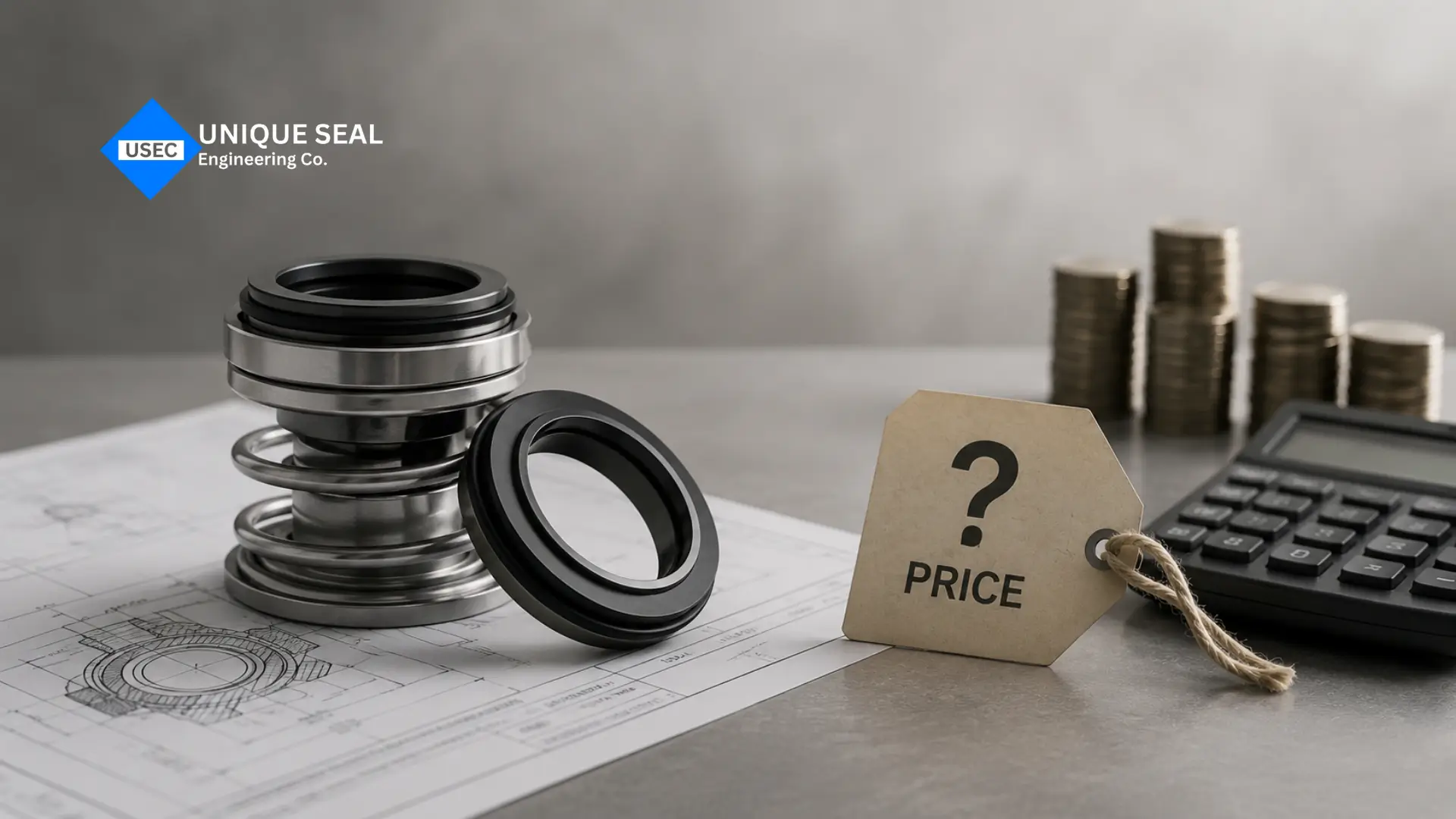
Think about asking "what's the price of a car in India?"
Sounds like a simple question.
It isn't.
A Maruti Alto and a Toyota Fortuner are both "cars." Both have 4 wheels, an engine, a steering wheel, and get you from point A to B.
One costs around ₹4 lakh. The other costs over ₹50 lakh.
Why the gap? Engine, materials, features, build quality, and the actual job each one is built to do.
A mechanical seal works exactly the same way.
A mechanical seal sealing a small water pump in a housing society and a seal sealing a high-pressure ammonia pump in a fertilizer plant are both, technically, "mechanical seals."
Ask for a price on either one without telling us which, and we genuinely can't answer. Not because we're hiding our pricing. Because the question itself is incomplete.
"Okay, got the car analogy. But why does the SAME job which is basically sealing a rotating shaft can cost so differently?"
Because two seals doing that exact same job can be built from completely different materials, configurations, and tolerances, depending on what fluid they're sealing, at what pressure, at what temperature, and in what kind of equipment.
Change any one of those variables, and the seal plus its price changes right along with it.
That's why mechanical seals don't carry a fixed, off-the-shelf price tag the way a bag of cement or a box of bolts does.
So instead of hunting for "the" price, here's what actually decides it.
What factors affect the price of a mechanical seal?
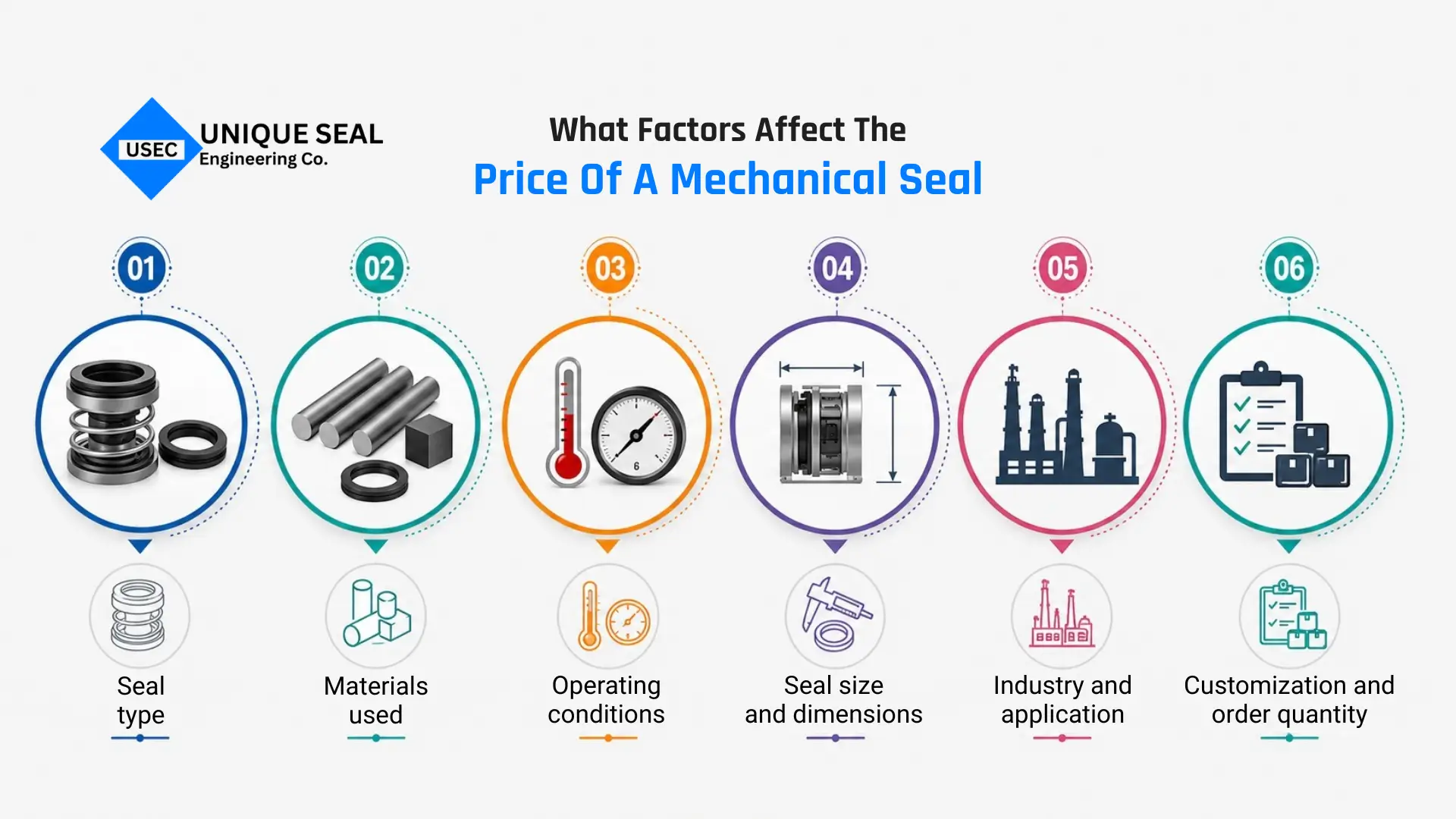
Seal type
Just like cars come in hatchback, sedan, and SUV body types, mechanical seals come in different configurations and each one is priced differently.
For example:
→ Pusher mechanical seals have simpler design, generally more affordable, suited for standard operating conditions.
→ Non-pusher mechanical seals are better suited for high temperatures and viscous fluids, slightly higher cost due to design complexity.
→ Single spring mechanical seals are economical and easy to install which is very common in smaller pumps.
→ Cartridge mechanical seals are pre-assembled on a sleeve and gland plate which make it easier and faster to install. But it cost higher than component seals because you're also paying for that built-in convenience and lower installation error.
If you're still figuring out which configuration fits your application, our guide on all types of mechanical seals breaks down every option in detail.
Materials used
This is usually where the BIGGEST price swings happen.
A mechanical seal has three material zones, and each one can be upgraded or downgraded independently:
→ Seal faces - carbon graphite, ceramic, silicon carbide, or tungsten carbide.
→ Elastomers/O-rings - NBR, EPDM, Viton (FKM), or Kalrez, depending on chemical compatibility with your process fluid.
→ Metal parts (sleeve, springs, gland plate) - SS304, SS316, Hastelloy, or Duplex steel for corrosive or high-pressure service.
Upgrade just the elastomer from NBR to Viton because your process fluid changed, and the price moves. Upgrade carbon faces to silicon carbide because your fluid now carries abrasive particles, and the price moves again.
Operating conditions
Pressure, temperature, and shaft speed (RPM) all decide how robust a seal needs to be.
A seal rated for 6 bar and 80°C is a very different build than a seal rated for 25 bar and 200°C, even if both are sealing the exact same shaft diameter.
For seals operating under hazardous or flammable conditions, API 682 and ATEX compliance requirements also come into play, which adds engineering, testing, and documentation cost.
Seal size and dimensions
Bigger shaft, bigger seal, more raw material, more machining time, its simple as that.
A 25mm seal and a 100mm seal aren't even in the same cost bracket, regardless of type or material, purely because of the volume of precision-machined material involved.
Industry and application
A seal for pump mechanical seals in plain water service has very different requirements than the same physical seal size used in pharma, chemical, or oil & gas applications.
→ Pharma needs FDA-compliant elastomers, traceable documentation, and often a mirror-polished surface finish.
→ Oil & gas often needs API 682 compliance, sour-service-rated materials, and double seal arrangements with a barrier fluid flush system.
→ Water treatment can usually run on standard catalog materials with no special certification needed.
Same dimensions on paper. Very different price tags.
Customization and order quantity
A custom-engineered seal built to match an obsolete pump's exact dimensions costs more than a standard catalog seal pulled off the shelf.
On the flip side, OEM and bulk orders bring the per-unit price DOWN, because tooling, setup, and face-lapping costs get spread across a larger quantity.
One seal ordered for an emergency breakdown will always cost more per unit than 50 seals ordered for a planned OEM production run.
Why can the same mechanical seal have different prices?
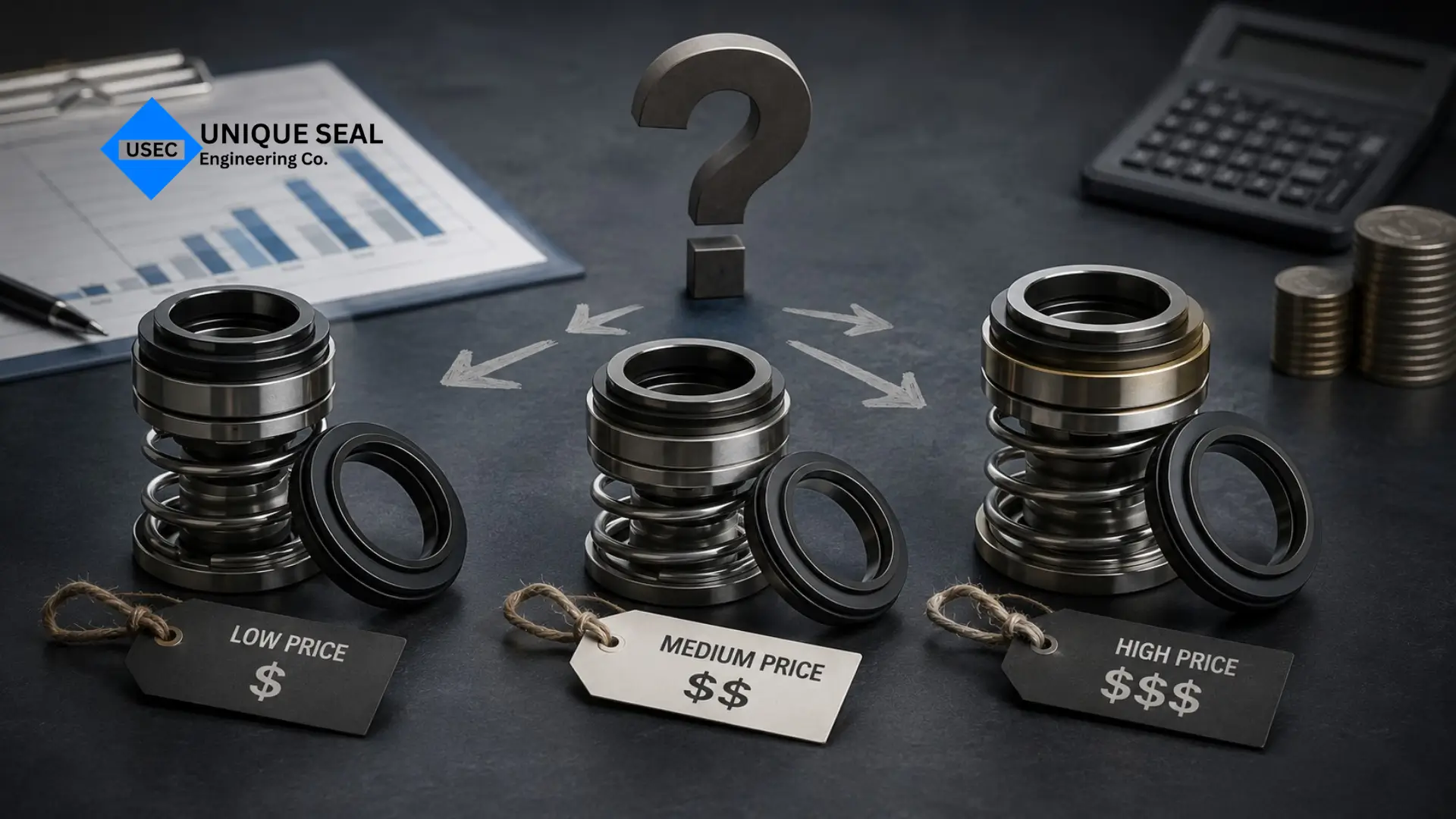
Here's where it gets interesting.
Take a single spring mechanical seal, 45mm shaft size with same basic design, same dimensions.
→ In a water treatment plant: Standard carbon vs ceramic faces, NBR O-rings, SS304 hardware. Straightforward. Lower cost.
→ In a chemical processing plant: Same 45mm seal, but now the process fluid is mildly corrosive. Faces upgrade to silicon carbide vs silicon carbide, O-rings move to Viton, hardware moves to SS316. Same size, noticeably higher cost.
→ In a pharmaceutical or oil & gas application: Same 45mm dimensions again, but now you need FDA traceability documentation, mirror-finish faces, possibly a double cartridge configuration with barrier fluid flush, and API 682 / ATEX compliance paperwork. Same seal size on paper, price has moved a long way from where it started.
So next time someone tells you "I'm paying X for a 45mm seal, why are you charging more for the same size," this is exactly why. Size is just one input out of many.
How material selection affects mechanical seal cost
Let me a simple breakdown of how face material alone shifts cost.
|
Material |
Relative Cost |
Typical Applications |
|
Carbon Graphite |
Low |
General applications |
|
Ceramic |
Low |
Water pumps |
|
Silicon Carbide |
High |
Corrosive & abrasive fluids |
|
Tungsten Carbide |
High |
Heavy-duty applications |
A quick way to read this table: carbon and ceramic are your "hatchback" materials that means they’re reliable, economical, perfectly suited for general-duty, non-aggressive service.
Silicon carbide and tungsten carbide are your "SUV" materials which are built for tougher terrain, literally. Abrasive slurries, corrosive chemicals, and heavy-duty continuous-run equipment need that extra hardness and chemical resistance, and you pay for it.
Choosing the wrong material to save cost upfront is exactly where the next section comes in.
Why buying the cheapest mechanical seal can cost more
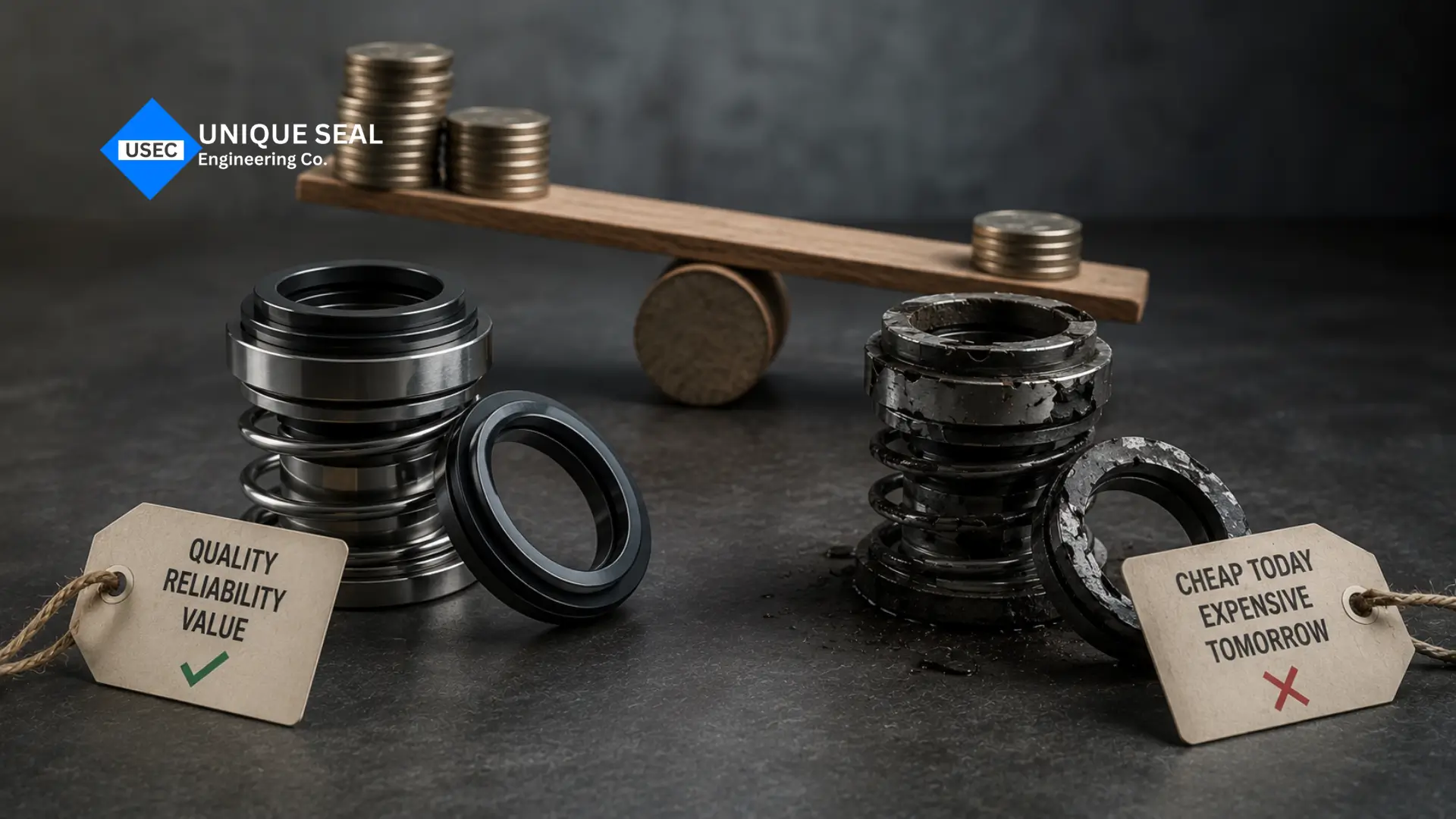
Imagine buying the cheapest car battery in the market to save ₹2,000 today.
It dies in 8 months instead of 3 years.
You pay for a replacement. You pay for a tow or a mechanic visit. You lose half a day dealing with a car that won't start.
Mechanical seals work the exact same way.
A low-cost seal that isn't matched to your actual operating conditions can have wrong material, wrong configuration, wrong size which doesn't just risk premature failure. It guarantees it, sooner or later.
And on top of that here's what that "savings" actually costs you down the line:
Frequent replacements: A seal failing every 2-3 months instead of running 12-18 months means you're buying the "cheap" seal 4-6X more often.
Equipment downtime: Every seal failure means stopping the pump, isolating the line, and losing production hours, sometimes an entire shift.
Higher maintenance costs: Labor, mechanic time, and associated parts (gaskets, fasteners) add up with every replacement cycle.
Increased total cost of ownership: Add purchase price + downtime + labor + lost production, and the "cheap" seal almost always ends up the most expensive option over a year.
The right question isn't "which seal is cheapest?" It's "which seal gives me the lowest cost per year of reliable operation?" Those are very often two completely different seals.
What information do you need to get an accurate quotation?
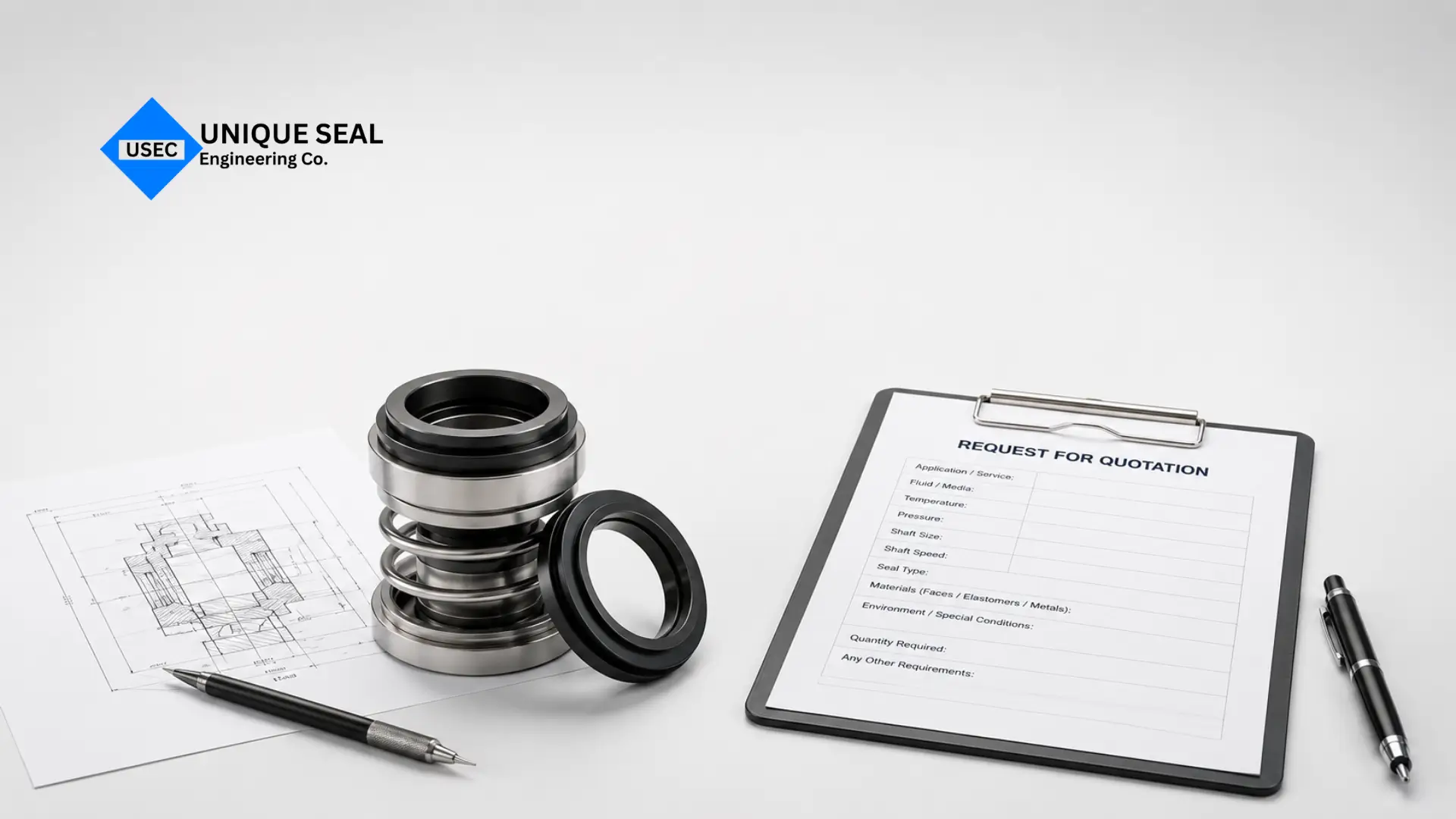
Just like a car dealer won't quote you a price without knowing the variant, fuel type, and accessories you want, we can't quote an accurate mechanical seal price without knowing your application.
Here's what helps us get you the right price, fast:
→ Pump make and model - helps us match seal dimensions to your existing equipment without guesswork.
→ Shaft size - the single most important dimension for fitment.
→ Process fluid - tells us which materials and elastomers will actually survive in your application.
→ Operating pressure and temperature - decides seal type, balance requirement, and whether you need a single or double seal arrangement.
→ Seal dimensions - if you have the existing seal or a drawing, this speeds up quoting massively.
→ Quantity required - single replacement unit, or bulk/OEM order as this directly affects per-unit pricing.
Share even 3-4 of these and we can usually get you a working estimate within hours, not days.
And if you're also working out procurement paperwork and tax classification alongside this, our guide on mechanical seal HSN code and GST rate covers exactly that.
How can Unique Seal Engineering Co. help you choose the right mechanical seal?
By now, you've probably realized that there isn't a single price for a mechanical seal.
The final cost depends on far more than just the seal size. Materials, operating pressure, temperature, process fluid, industry requirements, and even order quantity all play a role in determining the right solution and the right price.
That's why we don't believe in sending a generic price list that may not fit your application.
 Unique Seal Engineering Co. offers top-notch quality mechanical seals with a competitive mechanical seal cost.
At Unique Seal Engineering Co., we take the time to understand your equipment, operating conditions, and sealing requirements before recommending a solution. Whether you need a standard replacement seal, a cartridge mechanical seal, a custom-engineered design, or ongoing OEM supply, our team helps you choose a seal that delivers reliable performance and long-term value, not just the lowest upfront price.
Simply share your pump details, shaft size, process fluid, or even a photo of your existing seal. Our engineers will review your application and provide an accurate, application-specific quotation along with the most suitable sealing solution.
Get your free quote today and let our experts help you find the right mechanical seal for your application.
Frequently asked questions about mechanical seal prices
What is the average mechanical seal price in India?
There's no single average price because mechanical seal cost depends on seal type, materials, size, and application. A standard single spring seal for a small water pump can cost a fraction of a custom double cartridge seal built for a chemical or oil & gas application. Share your pump and application details for an accurate quote.
Why doesn't every mechanical seal have a fixed price?
Because two seals doing the exact same job can be built from different materials, configurations, and tolerances depending on the fluid, pressure, temperature, and industry they're used in. Even the same dimensions can carry very different prices depending on these factors.
What factors affect mechanical seal pricing?
The main factors are seal type (pusher, non-pusher, single spring, cartridge), face and elastomer materials, operating pressure and temperature, seal size, the industry/application it's used in, and whether it's a custom or bulk order.
Does seal material affect the cost?
Yes, significantly. Carbon graphite and ceramic faces sit on the lower end of the cost spectrum and suit general applications. Silicon carbide and tungsten carbide cost more but are necessary for corrosive, abrasive, or heavy-duty service.
How can I get a quotation?
Share your pump make and model, shaft size, process fluid, operating pressure and temperature, and quantity required. With these details, our team at Unique Seal can usually share an accurate quotation within hours.