
API 682 Mechanical Seal Piping Plans: Complete Guide to Flush Plans
Centrifugal pumps operating in petrochemical refineries, oil processing facilities, and chemical manufacturing plants rely on mechanical seals to keep hazardous liquids securely contained. However, a premium mechanical seal cannot function reliably without an appropriately matched auxiliary flush plan. According to industry reliability statistics, over 60% of premature pump seal failures stem directly from improper seal environment control rather than defects in the seal hardware itself.
The American Petroleum Institute standard API 682 outlines standardized seal piping flush plans engineered to optimize the operating environment around seal faces. These auxiliary systems regulate fluid temperature, dissipate frictional heat, flush away abrasive solids, prevent vapor locking, and provide secondary leak containment. Understanding these piping plans empowers maintenance managers and process engineers to significantly boost mean time between failures (MTBF).
Single Seal Flush Plans: Managing Heat and Particulates
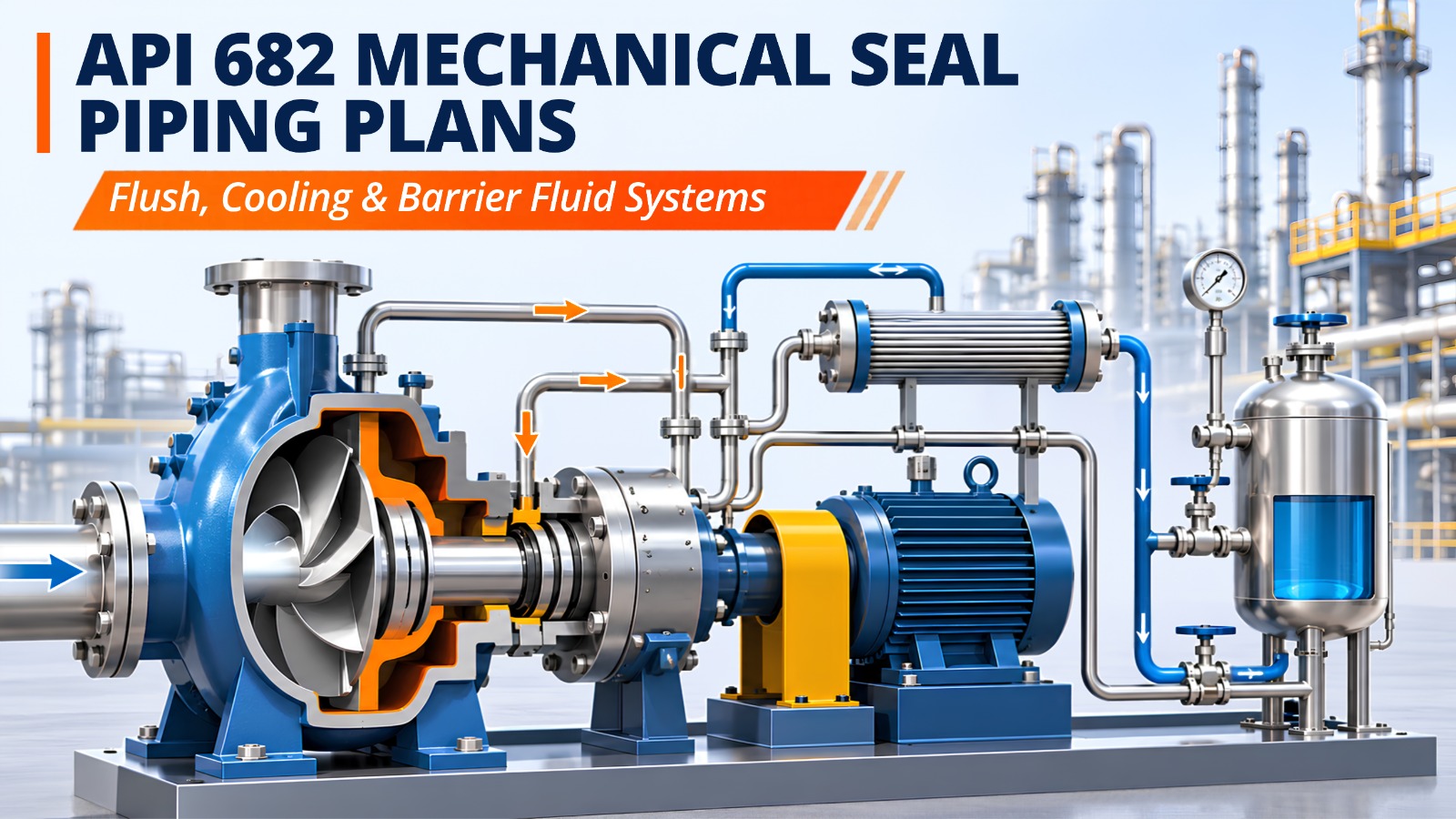
Single mechanical seals rely on process fluid circulation to cool and lubricate the mating faces. Standard API flush arrangements include:
API Plan 11 (Discharge Bypass Flush)
Plan 11 represents the standard default flush arrangement for clean, non-polymerizing process liquids. Fluid travels from the pump discharge nozzle, passes through an engineered metering orifice, and enters the seal chamber directly over the seal faces before returning to the pump suction stream. This continuous flow removes frictional heat and prevents thermal vapor pocket formation inside the seal housing.
API Plan 21 (Cooled Discharge Flush)
Similar to Plan 11, Plan 21 diverts liquid from pump discharge but directs it through an external shell-and-tube or finned heat exchanger before introducing it to the seal chamber. Cooling the flush liquid increases vapor margin, protecting elastomeric O-rings and preventing volatile hydrocarbons from flashing across seal faces.
API Plan 23 (Closed-Loop Cooled Recirculation)
Plan 23 is the premier, energy-efficient choice for high-temperature clean services such as boiler feed water and hot condensate pumps. An internal pumping ring on the rotating seal shaft circulates water through an external cooler and returns it directly to the seal chamber. Unlike Plan 21, Plan 23 cools only the isolated fluid inside the seal cavity rather than continuously chilling hot pump discharge flow, yielding substantial thermal energy savings.
API Plan 31 and Plan 32 (Solids Separation & External Clean Flush)
When handling slurries or particulate-laden liquids, Plan 31 routes discharge fluid through a cyclone separator, returning clean centrifugal flow to seal faces while returning concentrated solids to pump suction. Alternatively, Plan 32 injects an independent, clean external liquid source into the seal box, isolating seal components entirely from dirty or aggressive process media.
Dual Seal Flush Plans: Total Containment and Zero Emissions
When pumping toxic, carcinogenic, flammable, or environmentally sensitive fluids, dual seal configurations combined with specialized barrier fluid plans are mandatory to achieve zero atmospheric emissions:
API Plan 52 (Unpressurized Buffer Fluid System)
Utilized with dual unpressurized (tandem) seals, Plan 52 circulates an unpressurized buffer liquid from an external reservoir through the outer seal cavity. The buffer liquid cools the outboard seal faces while an overhead vent routes fugitive process leakage directly into a closed flare header or vapor collection system, providing clear visual indication of inner seal degradation.
API Plan 53A, 53B, and 53C (Pressurized Barrier Systems)
For zero-tolerance hazardous services, Plan 53 delivers clean barrier fluid to dual pressurized seals at a pressure maintained 1.5 to 2.0 bar higher than the seal chamber pressure:
- Plan 53A: Uses an external seal reservoir pressurized with an overhead nitrogen gas blanket. Reliable, straightforward, and widely used across hydrocarbon process plants.
- Plan 53B: Utilizes a pre-charged bladder accumulator, isolating nitrogen gas from the barrier fluid to eliminate gas absorption at high operating pressures.
- Plan 53C: Features a piston-type pressure tracking accumulator that automatically references seal chamber pressure, keeping barrier pressure proportional during dynamic system spikes.
How to Select the Right API Piping Plan for Your Pumps
Selecting the optimal piping plan involves evaluating fluid volatility, solids concentration, operating temperature, and emissions compliance thresholds. Review our engineering guide on why pump mechanical seals fail to identify operational factors damaging your equipment.
Engineered API Cartridge Seals from Unique Seal Engineering Co.
At Unique Seal Engineering Co., we design and manufacture precision-engineered single and dual cartridge mechanical seals fully compatible with API 682 flush plans. From integrated pumping rings to complete seal auxiliary cooler skids, our engineering solutions eliminate pump leakage and extend rotating equipment life.
Need expert assistance designing or upgrading your pump seal flush system? Contact our engineering specialists today or call +91-0120-4923910 for custom technical proposals.
Need a High-Reliability Replacement Mechanical Seal?
Unique Seal Engineering Co. manufactures Cartridge, Metal Bellows, PTFE Bellows, and Multi-Spring Seals with 100% optical flat inspection under monochromatic light at our Mohan Nagar, Ghaziabad facility. Get fast OEM-grade delivery across India and worldwide.
