

Complete Guide to Industrial Oil Seals: Types, Material Selection (NBR vs. FKM/Viton) & Shaft Sizing
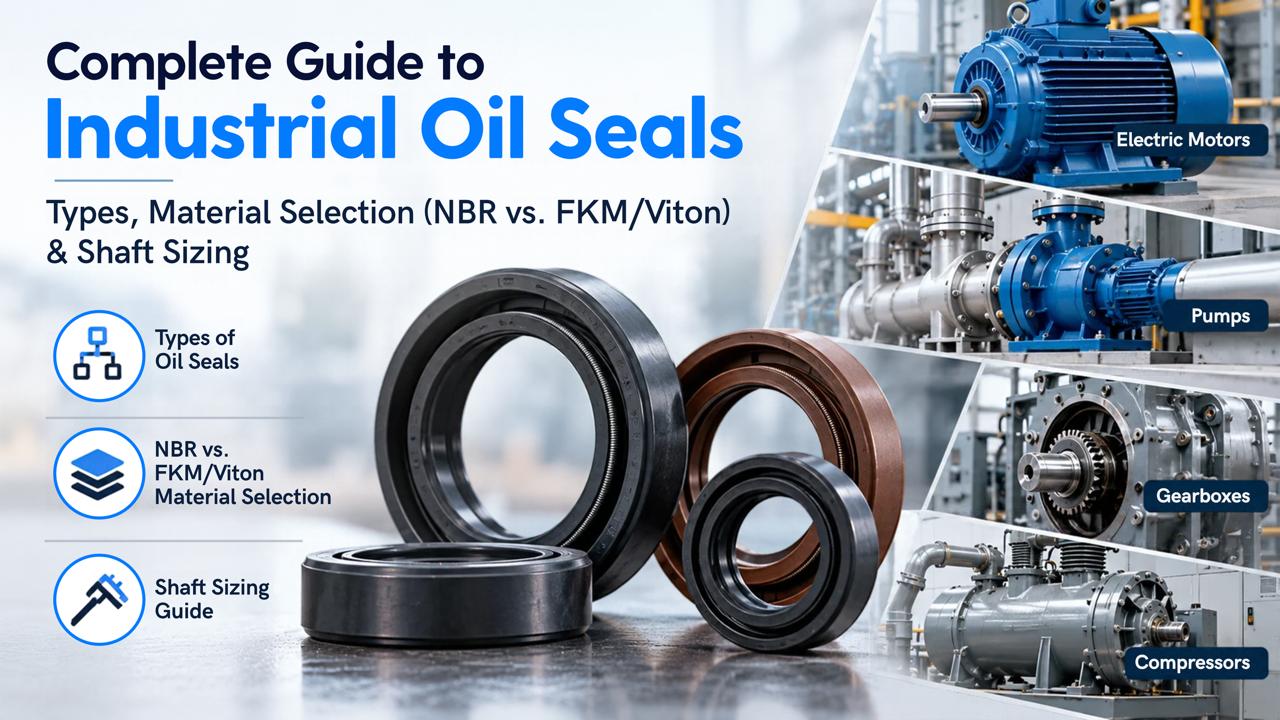
Industrial oil seals are essential components used to prevent lubricant leakage and protect machinery from dust, dirt, and other contaminants. They are widely used in industrial pumps, electric motors, gearboxes, compressors, and rotating equipment.
Choosing the right industrial oil seal depends on several factors, including seal type, material compatibility, operating temperature, shaft speed, and dimensions. This guide explains oil seal types, NBR vs. FKM/Viton materials, and shaft sizing to help engineers and buyers make informed decisions.
What Is an Industrial Oil Seal?
An industrial oil seal, also known as a rotary shaft oil seal, helps retain oil or grease inside machinery while preventing external contaminants from entering.
It typically consists of a sealing lip, an outer case, and sometimes a garter spring. These components work together to maintain sealing contact between the rotating shaft and stationary housing.
Why Are Oil Seals Important?
Industrial oil seals help reduce lubricant loss, protect bearings, minimize contamination, and support reliable machinery performance. Selecting the correct seal can also reduce maintenance costs and unexpected equipment downtime.
Types of Industrial Oil Seals
Different oil seal designs serve different operating conditions. Selecting the right type helps improve sealing performance and service life.
1. Single-Lip Oil Seals
Single-lip oil seals feature one primary sealing lip designed to retain lubricant. They are commonly used in electric motors, gearboxes, pumps, and general industrial machinery.
These seals are suitable for applications where lubricant retention is the main requirement and external contamination is relatively limited.
2. Double-Lip Oil Seals
Double-lip oil seals typically include a primary sealing lip and a secondary dust lip. The additional lip helps prevent dirt, dust, and moisture from entering the equipment.
They are often used in agricultural machinery, dusty industrial environments, and equipment exposed to external contaminants. However, additional lip contact may increase friction.
3. High-Temperature Oil Seals
High-temperature oil seals use elastomers selected for elevated operating temperatures and compatible fluids. FKM/Viton is a common option for applications requiring greater heat resistance than standard NBR compounds provide.
These seals are used in demanding industrial equipment, including certain pumps, compressors, and gearboxes.
NBR vs. FKM/Viton Oil Seals: Which Is Better?
Material selection directly affects an oil seal's durability, temperature resistance, and compatibility with lubricants.
NBR Oil Seals
Nitrile butadiene rubber (NBR) is widely used because of its good resistance to many mineral oils and greases, mechanical properties, and economical cost.
NBR oil seals are suitable for many standard industrial applications operating within the selected compound's temperature limits.
FKM/Viton Oil Seals
FKM is a fluoroelastomer known for its resistance to elevated temperatures and many oils, fuels, and chemicals. Viton is a recognized brand of FKM materials.
FKM oil seals are often preferred for demanding operating environments where standard NBR may not provide sufficient heat or fluid resistance.
NBR vs. FKM: Key Differences
|
Property |
NBR |
FKM/Viton |
|---|---|---|
|
Heat resistance |
Moderate |
Generally higher |
|
Mineral oil resistance |
Good |
Good to excellent |
|
Chemical resistance |
Fluid-dependent |
Broad, but fluid-dependent |
|
Relative cost |
Lower |
Higher |
|
Typical applications |
Standard machinery |
High-temperature applications |
Selection tip: Always verify the material's operating temperature and compatibility with the actual lubricant or chemical. Neither material is suitable for every application.
How to Measure Shaft Size for an Oil Seal
Correct sizing is essential to prevent leakage, premature wear, and installation problems.
1. Measure the Shaft Diameter
Use a suitable precision measuring instrument to measure the shaft diameter at the seal contact area. Check for scratches, wear grooves, corrosion, and uneven surfaces.
2. Check the Housing Bore
Measure the internal diameter of the housing where the seal will be installed. The seal's outside diameter must match the specified housing fit.
3. Confirm the Seal Width
Measure the seal width and available installation depth. A seal that is too wide or too narrow may not fit or function correctly.
4. Check Operating Conditions
Confirm shaft speed (RPM), temperature, lubricant type, pressure, and contamination exposure. These factors help determine the appropriate seal design and material.
A common oil seal specification is 30 × 52 × 7 mm, representing the nominal inside diameter, outside diameter, and width in millimetres.
Common Industrial Oil Seal Problems and Solutions
Oil seal failure can result from incorrect sizing, poor installation, excessive heat, or unsuitable materials.
Oil Leakage
Worn sealing lips, damaged shafts, incorrect dimensions, and excessive pressure can cause leakage. Inspect the shaft and housing before installing a replacement.
Premature Seal Wear
Excessive speed, contamination, poor surface finish, or insufficient lubrication can accelerate wear. Check operating conditions and follow the manufacturer's installation guidelines.
Cracking or Hardening
High temperatures and incompatible fluids may damage the elastomer. Consider a more suitable material, such as an appropriate FKM compound, when application requirements justify the change.
Industrial Applications of Oil Seals
Industrial oil seals are used across multiple sectors to support lubricant retention and equipment reliability.
Common applications include:
- Electric motors and gearboxes: Retaining lubricant around rotating shafts.
- Industrial pumps: Supporting sealing performance under application-specific conditions.
- Compressors: Helping prevent lubricant leakage.
- Agricultural machinery: Providing sealing and contamination protection.
- Automotive and transmission systems: Retaining fluids in rotating assemblies.
The correct seal depends on the equipment design, operating conditions, and manufacturer's specifications.
How to Choose an Oil Seal Manufacturer in India
When selecting an oil seal manufacturer in India, consider product quality, dimensional accuracy, material options, and technical support.
Choose a supplier that can help evaluate shaft dimensions, housing requirements, operating temperature, lubricant compatibility, and custom sealing needs.
Providing accurate application details also helps the supplier recommend a suitable industrial oil seal.
Conclusion: Select the Right Industrial Oil Seal
Choosing the right industrial oil seal requires accurate shaft sizing, suitable material selection, and an understanding of operating conditions.
Single-lip seals are suitable for many general applications, while double-lip designs offer additional contamination protection. NBR is a common economical choice, whereas FKM/Viton may be preferable for compatible high-temperature applications.
Need help selecting an industrial oil seal? Contact Unique Seal Engineering Co. to discuss your application requirements, material options, and custom sizing needs. Providing shaft dimensions, operating temperature, RPM, and lubricant details can help simplify the selection process.
Need a High-Reliability Replacement Mechanical Seal?
Unique Seal Engineering Co. manufactures Cartridge, Metal Bellows, PTFE Bellows, and Multi-Spring Seals with 100% optical flat inspection under monochromatic light at our Mohan Nagar, Ghaziabad facility. Get fast OEM-grade delivery across India and worldwide.
