
Agitator and Reactor Mechanical Seals: Selection, Design & Troubleshooting Guide
Agitators, industrial mixers, and chemical reactors operate under mechanical conditions vastly different from standard centrifugal pumps. While pumps run at high shaft speeds with short overhangs and minimal deflection, reactors feature long, cantilevered vertical shafts rotating at low to moderate speeds. These shafts frequently experience substantial radial runout, severe dynamic vibration, and continuous pressure fluctuations during critical process batches.
Standard pump mechanical seals fail rapidly when exposed to these extreme mechanical stresses. Sealing an industrial reactor requires specialized agitator mechanical seals engineered to accommodate large shaft movements while preserving absolute barrier integrity. Selecting the right reactor seal prevents costly product batch contamination, hazardous vapor escape, and emergency production halts across pharmaceutical, specialty chemical, and food manufacturing plants.
Critical Challenges in Agitator and Reactor Sealing
Industrial processing vessels present several formidable sealing hurdles that design engineers must address:
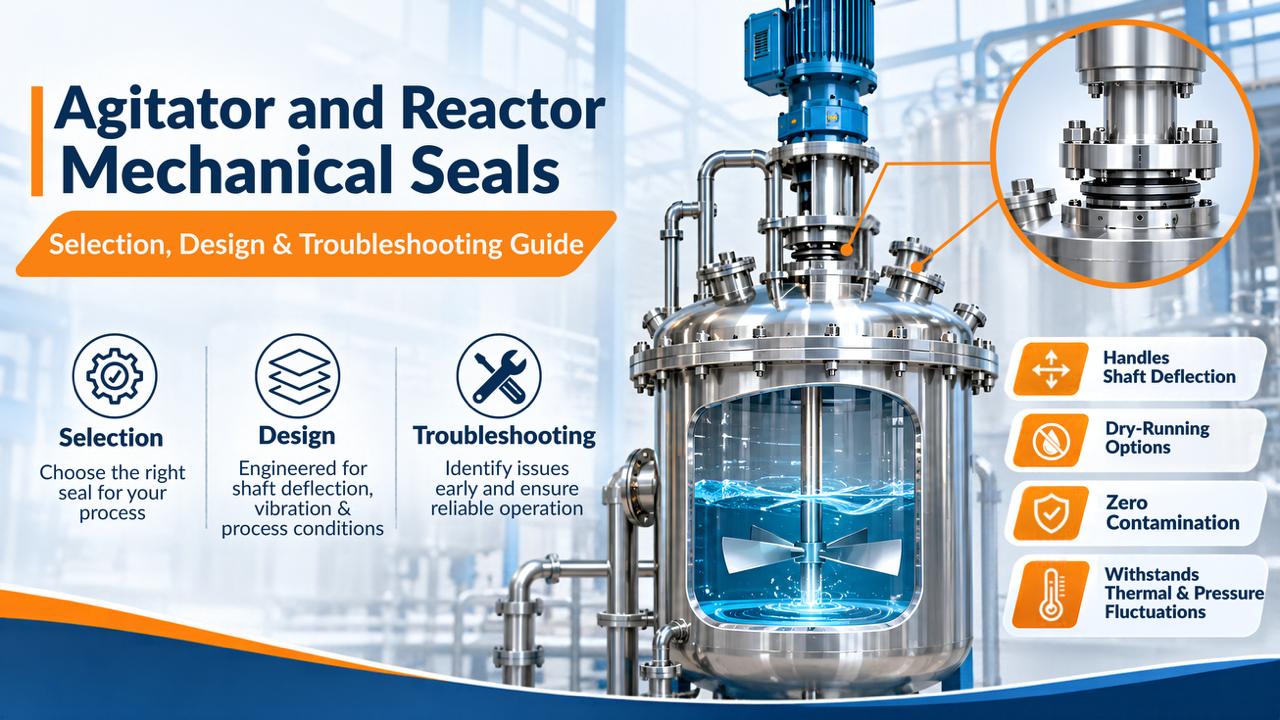
- Extreme Shaft Deflection: Long vertical mixer shafts naturally flex during turbulent agitation, solids dissolution, and heavy liquid phase mixing. Radial movement can exceed 1.5 mm to 3.0 mm, easily cracking rigid seal faces if not cushioned by flexible mountings.
- Run-Dry Conditions in the Vapor Phase: In top-entry vessels, seal faces operate directly within the gaseous headspace above the liquid level. Without adequate process liquid lubrication, conventional seal faces overheat within minutes.
- Strict Hygiene and Contamination Bans: Pharmaceutical synthesis and sterile food processing cannot tolerate barrier fluid leakage or wear particles entering the mixing batch.
- Thermal Cycling and Vacuum Swings: Reaction cycles often alternate from deep vacuum to high operating pressures, alongside extreme thermal gradients during heating and cooling phases.
Key Types of Agitator and Reactor Mechanical Seals
1. Dry-Running Mechanical Seals for Top-Entry Vessels
Top-entry vessels benefit greatly from dry-running mechanical seals. These seals utilize specialized self-lubricating face materials, such as premium electro-graphite or resin-impregnated carbon running against mirror-polished silicon carbide. Operating without liquid lubrication reservoirs eliminates the danger of barrier oil contaminating valuable reaction batches. Advanced non-contacting gas lubricated designs utilize nitrogen gas cushions to maintain frictionless, zero-wear operation.
2. Double Mechanical Seals with Barrier Fluid Systems
For aggressive chemicals, volatile toxic solvents, or pressurized gas reactions, double mechanical seals offer the highest protection. In this arrangement, two sets of precision-lapped seal faces enclose a dedicated barrier fluid chamber. Maintaining barrier fluid pressure slightly above vessel operating pressure prevents toxic chemical vapors from escaping into the facility atmosphere. Cartridge double seals like the US 043 DBL provide robust dual-layer containment.
3. Bottom-Entry and Side-Entry Mixer Seals
Bottom-entry and side-entry vessels place the mechanical seal directly beneath the liquid head, exposing faces to abrasive settling slurries and concentrated hydrostatic pressure. These configurations demand heavy-duty, debris-protected seal chambers, external flushes, and hard-faced materials such as reaction-bonded silicon carbide or tungsten carbide to withstand intense slurry erosion.
4. Glass-Lined Reactor Mechanical Seals
Glass-lined vessels in acid synthesis require specialized non-metallic wetted components. Seal housings are lined with PTFE, Hastelloy, or titanium, preventing acidic attack and avoiding micro-cracks in fragile glass nozzles.
Overcoming Shaft Deflection with Integrated Bearing Supports
The primary mechanical reason agitator seals fail prematurely is unmanaged shaft whip. High-performance reactor seals integrate a heavy-duty spherical roller bearing or angular contact ball bearing directly into the seal cartridge housing. This integrated bearing assembly stabilizes the mixer shaft at the exact point where it penetrates the vessel nozzle, absorbing dynamic bending forces before they reach the delicate lapped seal faces.
Best Practices for Agitator Seal Maintenance and Operation
Maximizing the operating life of mixer seals requires adherence to vital maintenance procedures:
- Always verify vessel alignment and drive gearbox concentricity before tightening seal cartridge locking collars.
- For wet-running dual seals, continuously monitor barrier fluid vessel pressure, coolant levels, and thermosiphon circulation loops.
- Inspect elastomer bellows and secondary O-rings for chemical swelling, hardening, or atmospheric ozone degradation during scheduled turnarounds.
- Never start agitator rotation under vacuum without confirming barrier gas supply pressure or lubricant availability in the reservoir.
Engineered Reactor Sealing from Unique Seal Engineering Co.
At Unique Seal Engineering Co., we design, engineer, and manufacture heavy-duty agitator, reactor, and mixer mechanical seals customized to your plant process vessel specifications. Whether you require sterile dry-running seals for pharmaceutical fermenters or robust double cartridge seals for high-pressure chemical reactors, our technical team delivers proven, zero-leakage reliability.
Protect your production batches and eliminate plant downtime today. Contact Unique Seal Engineering Co. or call +91-0120-4923910 to discuss custom agitator sealing configurations with our senior application engineers.
Need a High-Reliability Replacement Mechanical Seal?
Unique Seal Engineering Co. manufactures Cartridge, Metal Bellows, PTFE Bellows, and Multi-Spring Seals with 100% optical flat inspection under monochromatic light at our Mohan Nagar, Ghaziabad facility. Get fast OEM-grade delivery across India and worldwide.
