
Why Pump Mechanical Seals Fail: Top 5 Causes and How to Prevent Plant Downtime
Pumps are the heart of continuous plant operations across chemical, oil and gas, pharmaceutical, and water treatment facilities.
When a pump goes down unexpectedly, the culprit is almost always the same. Industry data shows that pump mechanical seal failure accounts for more than 60% of all centrifugal pump breakdowns.
Unplanned downtime leads to hazardous fluid leaks, costly secondary equipment damage, and heavy production losses.
Understanding the core mechanical seal leakage causes is essential to keeping your rotating equipment running reliably.
Here are the top five reasons seals fail and practical ways toa prevent pump seal failure across your plant.
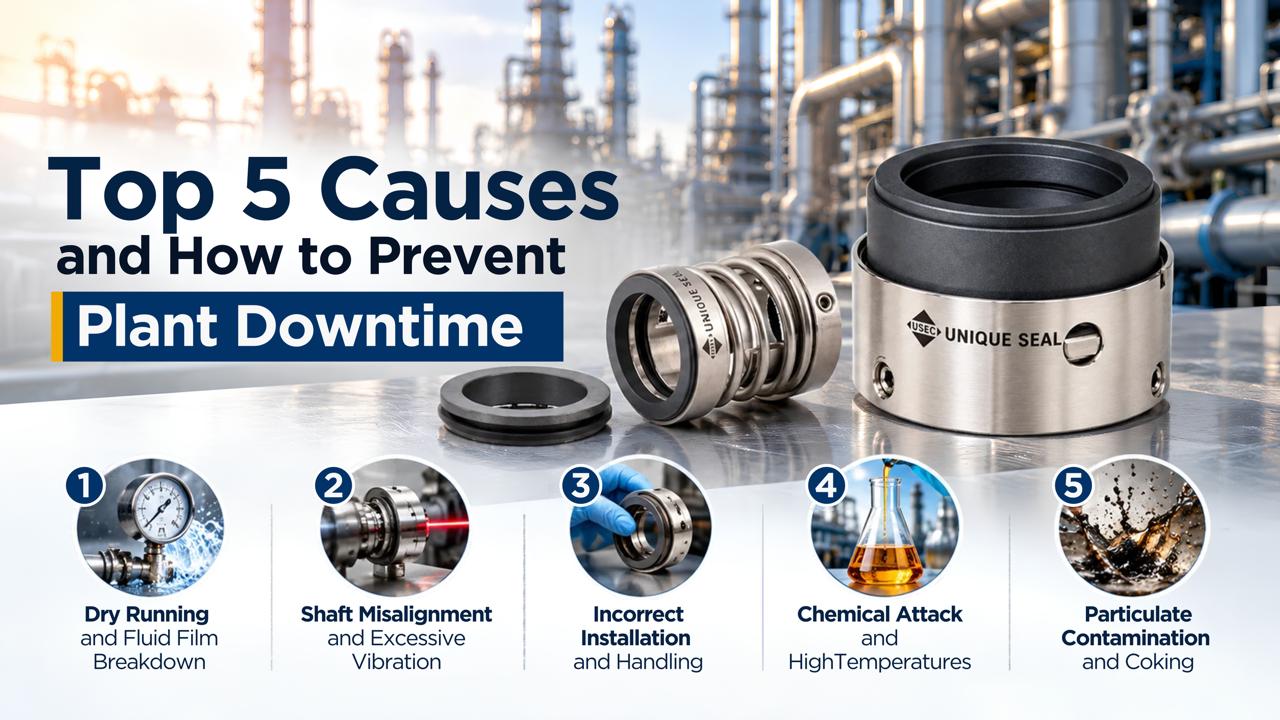
1. Dry Running and Fluid Film Breakdown
Mechanical seals need a microscopic lubricating film—just 1 to 2 microns thick—between their seal faces to prevent friction and heat buildup.
When a pump is started without proper venting or fluid priming, this fluid film instantly vaporizes. Cavitation and low suction pressure (NPSHa) can also starve the seal faces of fluid.
This leads to severe dry running seal damage. The face materials experience extreme thermal shock, causing heat checking, micro-cracks, and burnt secondary O-rings.
How to Prevent It:
- Never start a pump dry; implement automated low-flow and low-pressure shutdown switches.
- Inspect API seal flush plans (such as API Plan 11 or 32) to ensure a steady supply of clean flush fluid.
- Keep seal chamber pressure comfortably above the liquid's vapor pressure.
2. Pump Shaft Misalignment and Excessive Vibration
Mechanical seals are precision sealing interfaces, not load-bearing supports. They cannot tolerate severe radial play or angular movement.
Common causes include improper motor-to-pump coupling, pipe strain pushing against pump casings, and worn bearings.
Excessive pump shaft misalignment forces the dynamic seal face to wobble unevenly against the stationary face.
This creates an irregular wear pattern, dynamic O-ring fretting, and early spring fatigue.
How to Prevent It:
- Use precision laser alignment tools during installation to keep shaft runout within strict tolerances (<= 0.05 mm).
- Check for pipe strain by unbolting suction and discharge flanges during alignment checks.
- Implement routine vibration monitoring to identify bearing wear before it damages the seal.
3. Incorrect Installation and Handling
Mechanical seals are delicate precision assemblies. A significant number of seal failures occur within the first 24 to 48 hours of startup due to simple installation errors.
Touching polished seal faces with dirty hands transfers oil and grit that ruins face flatness.
Over-compressing springs or rolling an O-ring over a sharp shaft keyway creates an immediate leak path.
Experiencing Frequent Mechanical Seal Failures?
Recurrent seal leakage causes costly unplanned downtime, batch losses, and shaft fretting. Unique Seal Engineering Co. analyzes your exact operating parameters (shaft speed, fluid media, temperature, pressure) and provides custom face pairings and engineered seal recommendations.
Uneven tightening of gland bolts can also warp the stationary seal seat.
How to Prevent It:
- Upgrade to pre-assembled, factory-tested cartridge seals to eliminate manual setting mistakes.
- Protect O-rings with installation sleeves or guide tape when passing over sharp shoulders.
- Tighten gland bolts evenly using a torque wrench in a cross-star pattern.
4. Chemical Attack and High Temperatures
Process fluids can be corrosive, acidic, or extremely hot. Choosing mismatched materials leads to rapid seal breakdown.
When incompatible elastomers are exposed to aggressive chemicals or elevated temperatures, O-rings swell, become gummy, or turn brittle.
Corrosive liquids can also leach binders from carbon or tungsten carbide faces, creating rough, pitted contact surfaces.
How to Prevent It:
- Match seal elastomers (such as FKM, FFKM, or PTFE) strictly against chemical compatibility charts.
- Use hard-on-hard seal faces like silicon carbide for aggressive chemical applications.
- Install seal coolers, cooling jackets, or API Plan 21/23 heat exchangers for high-temperature pumps.
5. Particulate Contamination and Coking
Fluids containing suspended solids, slurries, or abrasive grit quickly destroy flat sealing surfaces.
Solids can wedge between the faces, acting like sandpaper and cutting concentric grooves into the seal materials.
Fluids that crystallize or coke when exposed to atmospheric air can also clog seal springs, causing the seal mechanism to hang up and leak.
How to Prevent It:
- Install API Plan 31 cyclone separators or filters to remove particulates from the flush stream.
- Use an external clean barrier fluid flush (API Plan 32) when pumping dirty slurries.
- Add an atmospheric water or steam quench (API Plan 62) to wash away crystallization behind the seal gland.
Quick Guide for Mechanical Seal Troubleshooting
- Radial heat cracks on faces: Caused by dry running. Vent the pump and check flush flow.
- Uneven wear tracks: Caused by shaft misalignment or bearing play. Perform laser alignment.
- Swollen or brittle O-rings: Caused by chemical attack. Upgrade to FFKM or PTFE elastomers.
- Deep circular grooves on faces: Caused by abrasive solids. Add filtration or an external flush.
- Leakage right after startup: Caused by cut O-rings or improper installation. Switch to cartridge seals.
Conclusion: Partner with Unique Seal Engineering Company for Zero-Downtime Reliability
Preventing pump mechanical seal failure starts with selecting the right seal design, using compatible materials, and adhering to strict installation practices.
When your process pumps run without unexpected interruptions, plant efficiency and profitability rise.
At Unique Seal Engineering Company, we manufacture and supply high-performance mechanical seals engineered to handle demanding industrial conditions.
From customized cartridge seals to application-specific face and elastomer combinations, our engineering team helps you eliminate leakage, lower maintenance costs, and maximize plant uptime.
Need a High-Reliability Replacement Mechanical Seal?
Unique Seal Engineering Co. manufactures Cartridge, Metal Bellows, PTFE Bellows, and Multi-Spring Seals with 100% optical flat inspection under monochromatic light at our Mohan Nagar, Ghaziabad facility. Get fast OEM-grade delivery across India and worldwide.
