Mechanical Seal Maintenance Checklist: A Complete Guide to Prevent Leaks and Extend Seal Life
Introduction
Mechanical seals play an important role in preventing fluid leakage from rotating equipment such as pumps, mixers, agitators, and other industrial machinery. However, even a high-quality mechanical seal can experience premature wear or failure if it is not properly installed, operated, and maintained.
A regular mechanical seal maintenance checklist helps maintenance teams identify early warning signs, maintain proper operating conditions, and reduce unexpected equipment downtime.
In this guide, we’ll cover the key inspection and maintenance steps for mechanical seals, common causes of failure, and practical ways to extend seal life.
What Is Mechanical Seal Maintenance?
- Mechanical seal maintenance involves regularly inspecting the seal and surrounding equipment to ensure that the sealing system is operating under suitable conditions.
Unlike some mechanical components, a properly operating mechanical seal should not require frequent adjustment. Instead, maintenance focuses on:
Checking for abnormal leakage
Inspecting seal components
Monitoring pump operating conditions
Checking vibration and alignment
Maintaining proper lubrication or cooling
Preventing contamination
Identifying abnormal temperature or pressure
Replacing worn components when necessary
Following a structured maintenance schedule can help detect problems before they develop into major equipment failures.
Mechanical Seal Maintenance Checklist
Use the following checklist as part of your routine pump and equipment maintenance program.
1. Check for Excessive Leakage
One of the first things to inspect is the area around the mechanical seal.
A properly functioning seal should control leakage within the limits appropriate for its design and application. Excessive or rapidly increasing leakage can indicate problems such as:
• Damaged seal faces
• Worn O-rings
• Incorrect installation
• Shaft movement
• Misalignment
• Excessive vibration
• Incorrect operating conditions
If leakage suddenly increases, investigate the cause instead of simply replacing the seal.
2. Inspect the Seal Faces
The seal faces are among the most critical components of a mechanical seal.
During planned maintenance, inspect the sealing faces for:
• Scratches
• Cracks
• Chipping
• Uneven wear
• Scoring
• Excessive deposits
• Heat damage
Damage to the faces can reduce sealing performance and eventually result in leakage.
For applications involving abrasive or corrosive fluids, selecting appropriate face materials is particularly important.
3. Check Shaft and Sleeve Condition
The mechanical seal operates around a rotating shaft or shaft sleeve. Any damage in this area can affect sealing performance.
Inspect for:
• Shaft wear
• Corrosion
• Grooves
• Surface damage
• Excessive runout
• Deposits
A damaged shaft or sleeve should be addressed before installing a new mechanical seal.
4. Monitor Pump Vibration
Excessive vibration is a common warning sign that should not be ignored.
High vibration can result from:
• Misalignment
• Bearing problems
• Shaft imbalance
• Cavitation
• Improper installation
• Operating the pump outside its intended conditions
Excessive vibration can place additional stress on the mechanical seal and accelerate wear.
Therefore, vibration monitoring should be included in a regular mechanical seal maintenance checklist.
5. Check Shaft Alignment
Proper alignment between the motor, pump, and shaft is essential for reliable operation.
Misalignment can cause:
• Uneven seal-face loading
• Excessive vibration
• Shaft movement
• Premature seal wear
• Increased leakage
Alignment should be checked using appropriate measurement equipment during installation and planned maintenance.
6. Monitor Temperature
Abnormally high temperatures around the seal can indicate inadequate cooling, excessive friction, dry running, or unsuitable operating conditions.
Monitor:
• Seal temperature
• Pump temperature
• Process-fluid temperature
• Cooling-fluid temperature
Always ensure that the mechanical seal is being operated within the temperature limits specified for its materials and design.
7. Check Pressure and Operating Conditions
Mechanical seals are designed for specific operating conditions.
Regularly verify:
• Pump pressure
• Temperature
• Speed
• Fluid characteristics
• Flow conditions
• Seal chamber pressure
Operating outside the seal's design parameters can significantly reduce its service life.
8. Inspect O-Rings and Secondary Seals
O-rings and other secondary sealing elements should be checked during planned maintenance.
Look for:
• Cracks
• Hardening
• Swelling
• Cuts
• Chemical degradation
• Loss of elasticity
The material of the O-ring should be compatible with the pumped fluid and operating temperature.
9. Check Cooling and Flush Systems
Many mechanical seals depend on cooling, flushing, or lubrication systems to maintain suitable operating conditions.
Check that:
• Flush lines are open
• Cooling flow is adequate
• Filters are clean
• Pressure is correct
• Lines are not blocked
• Cooling fluid is suitable
A blocked or improperly adjusted flush system can contribute to premature seal failure.
10. Check for Dry Running
Dry running is one of the most serious conditions for many mechanical seals.
Mechanical seal faces generally depend on a controlled fluid film for cooling and lubrication. Running without sufficient fluid can cause rapid temperature increase and seal-face damage.
Before starting equipment, verify that:
• The pump is properly primed
• The seal chamber has the required fluid
• Flush/cooling systems are operating
• Valves are correctly positioned
Avoid operating the equipment outside its intended conditions.
11. Inspect Bearings and Coupling
Mechanical seal performance is closely connected to the overall condition of the rotating equipment.
During maintenance, inspect:
• Bearings
• Couplings
• Shaft alignment
• Motor condition
• Shaft runout
Problems elsewhere in the equipment can transfer vibration or movement to the mechanical seal.
12. Keep the Seal Area Clean
Dirt, dust, process deposits, and contaminants can interfere with maintenance and inspection.
Keep the area around the mechanical seal clean so that:
• Leakage can be identified easily
• Inspection is easier
• Contamination is reduced
• Maintenance personnel can identify changes quickly
For critical equipment, maintaining a clean inspection area can make it easier to identify developing problems.
Mechanical Seal Maintenance Schedule
A practical maintenance program can be divided into three levels.
Daily / Routine Inspection
Check:
• Visible leakage
• Abnormal noise
• Excessive vibration
• Temperature changes
• Pump operating conditions
Weekly or Periodic Inspection
Check:
• Flush and cooling systems
• Shaft and coupling condition
• Leakage trends
• Equipment alignment indicators
• Seal chamber conditions
Planned Maintenance
Inspect:
• Seal faces
• O-rings
• Springs
• Shaft/sleeve
• Seal housing
• Bearings
• Coupling
• Alignment
The exact schedule should be adjusted according to the equipment, application, operating conditions, manufacturer recommendations, and criticality of the equipment.
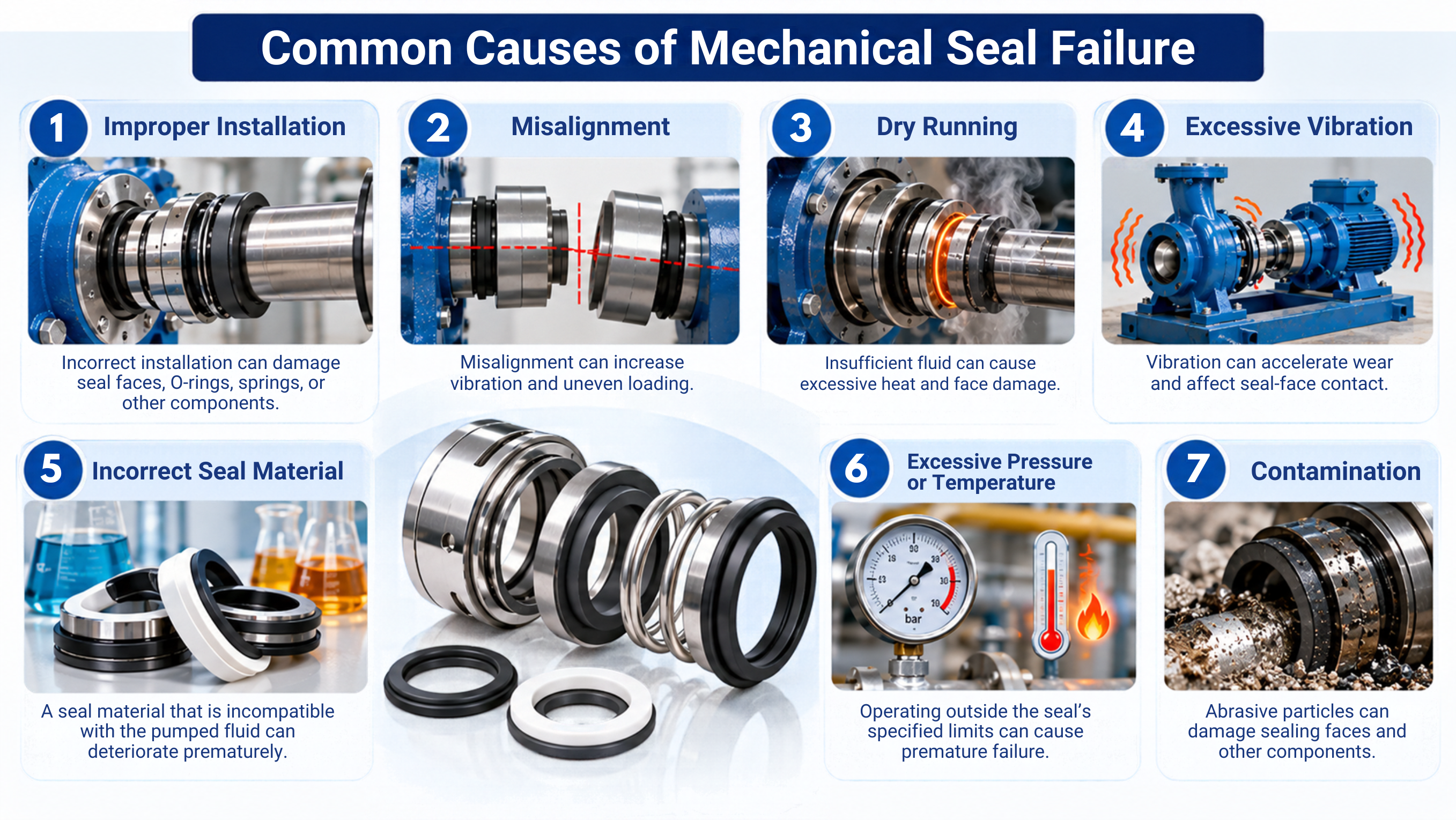
Common Causes of Mechanical Seal Failure
Even with regular maintenance, mechanical seals can fail if underlying problems are not corrected.
Common causes include:
1. Improper Installation
Incorrect installation can damage seal faces, O-rings, springs, or other components.
2. Misalignment
Misalignment can increase vibration and uneven loading.
3. Dry Running
Insufficient fluid can cause excessive heat and face damage.
4. Excessive Vibration
Vibration can accelerate wear and affect seal-face contact.
5. Incorrect Seal Material
A seal material that is incompatible with the pumped fluid can deteriorate prematurely.
6. Excessive Pressure or Temperature
Operating outside the seal's specified limits can cause premature failure.
7. Contamination
Abrasive particles can damage sealing faces and other components.
How to Extend Mechanical Seal Service Life
Following a maintenance checklist is only one part of improving seal reliability.
Here are several practical steps:
1. Select the correct mechanical seal for the application.
2. Use compatible seal-face and elastomer materials.
3. Maintain correct pump alignment.
4. Prevent dry running.
5. Monitor vibration and temperature.
6. Maintain proper flush and cooling systems.
7. Follow the manufacturer's installation instructions.
8. Avoid operating the pump outside its design conditions.
9. Investigate leakage instead of ignoring it.
10. Replace damaged components during planned maintenance.
Choosing the Right Mechanical Seal
Maintenance alone cannot compensate for an incorrectly selected seal.
The appropriate seal should be selected according to factors such as:
• Pump type
• Shaft diameter
• Operating speed
• Pressure
• Temperature
• Fluid characteristics
• Chemical compatibility
• Abrasive content
• Seal chamber conditions
For demanding applications, custom mechanical seals or engineered sealing solutions may be required.
Unique Seals can use this section to internally link to its relevant mechanical seal product categories, OEM solutions, and custom sealing solutions.
Mechanical Seal Maintenance Checklist — Quick Reference
Inspection Point What to Check
Leakage Excessive or increasing leakage
Seal faces Wear, scratches, cracks and deposits
Shaft Grooves, corrosion and runout
Vibration Abnormal or increasing vibration
Alignment Motor, pump and shaft alignment
Temperature Abnormal seal or process temperature
Pressure Operating pressure within design range
O-rings Cracks, hardening and chemical damage
Flush system Flow, pressure and blockage
Cooling Adequate cooling
Bearings Wear and abnormal noise
Coupling Condition and alignment
Operating conditions Speed, pressure, temperature and fluid
Cleanliness Contamination and deposits
Conclusion
A consistent mechanical seal maintenance checklist can help maintenance teams identify developing problems before they result in major leakage, equipment downtime, or unexpected seal replacement.
The most important practices are regular inspection, proper alignment, monitoring vibration and temperature, maintaining adequate cooling or flushing, preventing dry running, and selecting a mechanical seal suitable for the application.
For industrial equipment operating under demanding conditions, choosing the correct seal design and materials is just as important as maintaining the equipment.
Unique Seals can support industrial applications with mechanical sealing solutions designed around equipment requirements, operating conditions, and application needs.