Mechanical Seal for Pump: Complete Guide to Types, Applications & Selection
A mechanical seal for pump is a critical component used to prevent fluid leakage between the rotating shaft and stationary housing of a pump. Whether a pump handles water, chemicals, slurry, oil, wastewater, or other industrial fluids, the right mechanical seal helps maintain reliable operation and minimize leakage and unplanned maintenance.
Unlike traditional packing arrangements, modern mechanical seals are engineered to provide controlled sealing performance under specific pressure, temperature, speed, and fluid conditions.
For industrial applications, selecting the correct seal is not simply about matching the shaft size. The process fluid, operating pressure, temperature, pump speed, equipment design, and material compatibility all influence seal performance.
Unique Seal Engineering Co. manufactures and supplies mechanical sealing solutions for pumps and other rotating equipment, with products designed for demanding industrial applications.
What Is a Mechanical Seal for Pump?
A mechanical seal is a precision-engineered sealing device installed around the rotating shaft of a pump. Its primary purpose is to prevent the pumped fluid from escaping along the shaft while also preventing external contaminants from entering the equipment.
A typical pump mechanical seal consists of:
Rotary seal face
Stationary seal face
Secondary seals
Springs
Retainer or metal components
Shaft or sleeve interface
The two primary sealing faces are pressed together during operation. A very thin fluid film between the faces helps reduce friction and wear while maintaining the required sealing function.
For applications where leakage control, reliability, and maintenance are important, a properly selected mechanical seal for pump can be an essential part of the overall pump system.
How Does a Pump Mechanical Seal Work?
The working principle of a mechanical seal is relatively simple, but the engineering behind it is highly precise.
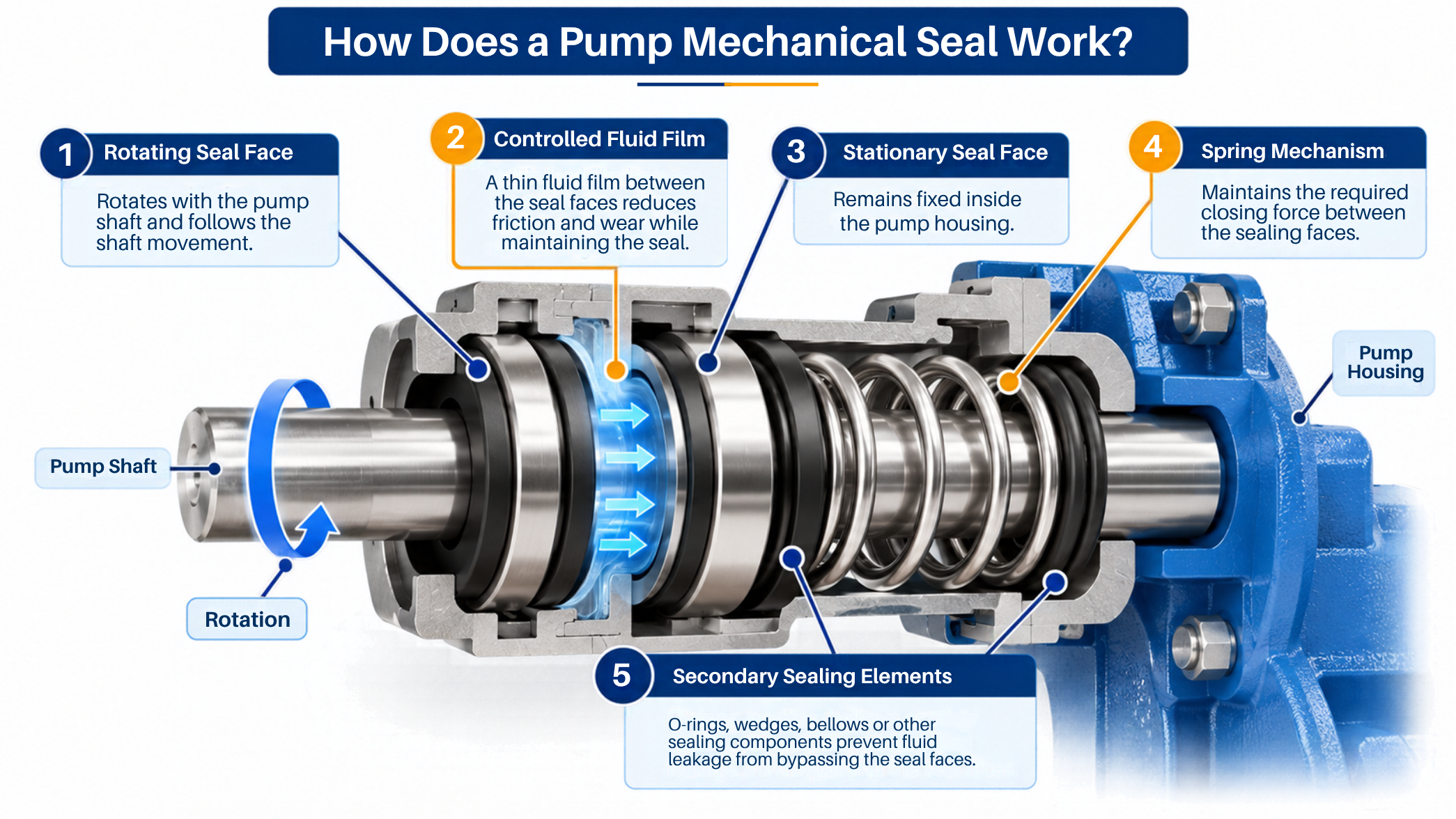
When the pump operates, the shaft and rotating seal components rotate while the stationary components remain fixed. The rotating and stationary seal faces maintain contact and create a controlled sealing interface.
1. Rotating Seal Face
The rotating face follows the movement of the pump shaft.
2. Stationary Seal Face
The stationary face remains fixed inside the pump housing or seal chamber.
3. Secondary Sealing Elements
O-rings, wedges, bellows, or other secondary sealing components help prevent fluid from bypassing the primary seal faces.
4. Spring Mechanism
The spring or spring arrangement maintains the required closing force between the sealing faces.
5. Controlled Fluid Film
During operation, a microscopic fluid film can exist between the faces. This helps control friction, heat generation, and wear.
The exact design varies depending on the application and seal type.
Why Is a Mechanical Seal Important for Pumps?
Pump leakage can result in product loss, contamination, maintenance problems, environmental concerns, and equipment downtime.
A properly selected mechanical seal can help:
Reduce fluid leakage
Improve pump reliability
Reduce maintenance requirements
Protect the pump shaft and surrounding components
Support continuous industrial operation
Reduce product loss
Improve workplace cleanliness
Extend maintenance intervals when correctly applied
For this reason, mechanical seals are widely used in industrial pumps across chemical processing, pharmaceuticals, food and beverage, paper and pulp, wastewater, petrochemical, sugar, power, and other industries.
Types of Mechanical Seals for Pumps
Different pumps and process conditions require different seal configurations. The most suitable option depends on the operating environment and equipment design.
1. Single Mechanical Seal
A single mechanical seal uses one primary pair of sealing faces.
It is commonly used for applications where the pumped fluid can be safely contained using a single sealing arrangement.
Typical applications include:
Water pumps
General industrial pumps
Process pumps
Circulation systems
Utility applications
Single seals are often selected for relatively straightforward applications where the process conditions are compatible with the seal materials.
2. Balanced Mechanical Seal
A balanced seal is designed to reduce the hydraulic loading acting across the sealing faces.
This makes balanced designs useful in applications involving higher pressure or demanding operating conditions.
A balanced mechanical seal can be considered when the pump operates with:
Higher pressure
Higher shaft speeds
Continuous operation
More demanding process conditions
The correct design should always be selected according to the manufacturer's operating limits.
3. Pusher Mechanical Seal
Pusher seals use a secondary sealing element that moves axially with the seal assembly to accommodate certain shaft movement and operating conditions.
They are commonly used in industrial pumps because of their versatile design.
For example, US ARO-SP from Unique Seal Engineering Co. is a pusher seal designed for pumps and demanding slurry applications. The design incorporates a helical coil spring and is intended for applications involving contaminated or suspended-solid media.
Related product: US ARO-SP - Pusher Seal for Pumps
4. Cartridge Mechanical Seal
Cartridge mechanical seals are supplied as a pre-assembled unit, which can simplify installation and help reduce certain installation-related errors.
They are commonly considered for industrial equipment where:
Installation time is important
Consistent setup is required
Maintenance teams need easier replacement
Pump downtime needs to be controlled
Unique Seal Engineering Co. also offers US 5008 Single Cartridge Seal as part of its mechanical seal product range.
Related product:
US 5008 Single Cartridge Seal
5. Multispring Mechanical Seal
Multispring seals use multiple springs to distribute the closing force around the sealing assembly.
They can be suitable for various industrial pump applications where consistent loading and compact seal construction are required.
Unique Seal Engineering Co. offers models including US 1007/1008 and US P-31 within its product range.
6. Metal Bellow Mechanical Seal
Metal bellow seals use a metallic bellows element instead of a conventional dynamic secondary seal arrangement.
They can be useful in applications involving challenging temperatures, chemicals, or process conditions, depending on the selected materials and design.
Unique Seal Engineering Co. offers US MBG/US MBVT and US MB metal bellow seal designs.
7. Double Mechanical Seal
A double mechanical seal uses two sealing interfaces and is generally selected for applications where additional containment or controlled sealing arrangements are required.
These systems can be considered for:
Hazardous fluids
Toxic or aggressive chemicals
Difficult-to-seal process fluids
Applications requiring additional leakage control
The correct arrangement depends on the pump, process fluid, pressure, temperature, and support system.
For more information, see our related guide:
What is Double Mechanical Seal: Types and Applications
Mechanical Seal Materials for Pumps
Material selection is one of the most important factors when choosing a mechanical seal.
The sealing materials must be compatible with the process fluid and operating conditions.
Common materials include:
Carbon
Carbon-based seal faces are widely used in many industrial applications because of their good tribological properties.
Silicon Carbide
Silicon carbide offers high hardness and good wear resistance, making it suitable for demanding applications.
Ceramic
Ceramic materials may be used in selected applications depending on chemical compatibility and operating conditions.
Stainless Steel
Stainless steel is commonly used for metallic components because of its strength and corrosion resistance.
Elastomers
Depending on the application, secondary sealing elements may include:
NBR
EPDM
FKM
FFKM
For example, the US M7N range lists materials including silicon carbide, carbon graphite, stainless-steel components and elastomers such as EPDM, NBR, FKM and FFKM.
How to Choose the Right Mechanical Seal for Pump?
Choosing the right pump seal requires more than knowing the pump model.
Consider the following factors.
1. Pump Shaft Size
The seal must match the required shaft or sleeve dimensions.
An incorrect size can result in installation problems, leakage, or premature failure.
2. Pump Operating Pressure
Seal design should be selected according to the actual operating pressure.
High-pressure applications may require a balanced seal or another application-specific design.
3. Operating Temperature
Temperature affects seal faces, elastomers, springs, and other components.
Always verify the seal's temperature range before installation.
4. Process Fluid
Identify exactly what fluid the pump is handling.
Water, oil, acids, solvents, slurry, chemicals, and wastewater can require very different sealing materials.
5. Pump Speed
Pump RPM affects heat generation, seal-face behavior, and overall operating conditions.
The seal must be suitable for the pump's operating speed.
6. Solids or Abrasive Particles
Slurry and contaminated fluids can create additional challenges.
For such applications, a seal specifically designed to resist clogging and handle suspended solids may be more suitable.
For example, the US ARO-SP is designed for slurry and contaminated media applications and includes features intended to reduce clogging.
7. Chemical Compatibility
For corrosive or chemically aggressive fluids, all wetted and sealing materials must be evaluated for compatibility.
Common Applications of Mechanical Seals for Pumps
Mechanical seals are used across a wide range of industries.
Chemical Processing
Chemical pumps often handle aggressive fluids that require carefully selected seal materials.
Pharmaceutical Industry
Process equipment may require reliable sealing and suitable material selection for hygienic and controlled environments.
Food & Beverage
Pump sealing solutions are used in various liquid-handling and processing applications.
Water & Wastewater
Mechanical seals are commonly used in pumps handling water, wastewater, sludge, and related fluids.
Paper & Pulp
Pumps handling process fluids and slurry can require application-specific mechanical seals.
Sugar Industry
Industrial pumps used in sugar processing may require robust sealing solutions for continuous operation.
Oil & Gas
Process and transfer pumps can operate under demanding pressure, temperature, and fluid conditions.
Petrochemical Industry
Pumps handling hydrocarbons and chemicals require sealing systems selected according to the specific process conditions.
Unique Seal Engineering Co. lists industries including chemical processing, pharmaceuticals, sugar, food & beverage, steel, power & energy, paper, oil & gas, petrochemical, paint, and pumps & compressors.
Signs That a Pump Mechanical Seal Needs Replacement
A mechanical seal may require inspection or replacement when you notice:
1. Visible Leakage
Continuous or increasing leakage around the pump shaft area should be investigated.
2. Excessive Heat
Unusual heat near the seal area can indicate inadequate lubrication, incorrect installation, misalignment, or unsuitable operating conditions.
3. Unusual Noise
Abnormal noise or vibration can indicate problems involving the pump, shaft, bearings, alignment, or mechanical seal.
4. Frequent Seal Failure
Repeated seal failures may indicate that the selected seal is not suitable for the actual process conditions.
5. Reduced Pump Reliability
Frequent maintenance and unexpected shutdowns may indicate an underlying sealing or equipment issue.
It is important to identify the root cause instead of simply replacing the seal repeatedly.
For a detailed troubleshooting resource, read:
How to Prevent Mechanical Seal Failure: Common Causes, Warning Signs & Solutions
Mechanical Seal vs. Traditional Pump Packing
Mechanical seals and packing systems both serve the purpose of controlling leakage around rotating shafts, but their construction and operating characteristics differ.
Feature
Mechanical Seal
Packing
Leakage control
Generally very low when properly selected
Usually controlled leakage
Maintenance
Often lower routine adjustment
May require regular adjustment
Installation
Requires precision
Generally simpler
Shaft contact
Seal faces create the primary sealing interface
Packing contacts shaft/sleeve
Applications
Wide range of industrial pumps
Selected applications
The appropriate choice depends on the pump design, process requirements, maintenance philosophy, and operating conditions.
How to Extend Mechanical Seal Life
Correct selection is only the first step. Proper installation and pump operation are equally important.
Follow Correct Installation Procedures
Seal faces should be handled carefully and kept clean during installation.
Check Pump Alignment
Misalignment can contribute to vibration and premature seal wear.
Maintain Proper Operating Conditions
Avoid operating the pump outside the recommended pressure, temperature, and speed range.
Prevent Dry Running
Many mechanical seals depend on an appropriate fluid film for cooling and lubrication. Operating a seal without suitable lubrication can cause rapid damage.
Inspect Related Pump Components
Shaft condition, bearings, sleeves, coupling, alignment, and pump hydraulics can all influence seal performance.
Why Choose Unique Seal Engineering Co. for Pump Mechanical Seals?
Unique Seal Engineering Co. is an Indian manufacturer focused on mechanical sealing solutions for pumps, compressors, mixers, agitators, and other rotating equipment.
The company states that its manufacturing approach emphasizes precision, quality-controlled processes, material expertise, and application-specific engineering.
Its product range includes multiple mechanical seal configurations, allowing customers to select solutions based on different equipment and operating requirements.
For demanding applications, products such as US ARO-SP are designed specifically for pump and slurry applications, while US M7N is designed for industrial applications involving pumps, compressors, and mixers.
If you are unsure which seal is suitable for your pump, providing the pump model, shaft size, fluid, pressure, temperature, and RPM can help the technical team identify an appropriate configuration.
Explore Unique Seal Engineering Co. Mechanical Seal Products
Frequently Asked Questions About Mechanical Seal for Pump
What is a mechanical seal for pump?
A mechanical seal for pump is a sealing device used around a rotating pump shaft to control fluid leakage between the rotating shaft and stationary pump housing.
Which mechanical seal is best for a centrifugal pump?
There is no single seal that is suitable for every centrifugal pump. Selection depends on shaft size, fluid, pressure, temperature, speed, pump design, and other operating conditions.
How long does a pump mechanical seal last?
Seal life varies significantly depending on the application, installation, operating conditions, materials, pump alignment, fluid characteristics, and maintenance practices.
Can a mechanical seal be used for water pumps?
Yes. Mechanical seals are widely used in water-handling pumps. The specific seal should be selected according to the pump design and operating conditions.
What causes mechanical seal failure in pumps?
Common contributing factors include dry running, incorrect installation, shaft misalignment, excessive vibration, unsuitable materials, contaminated fluid, excessive temperature or pressure, and operating outside the seal's design limits.
Can Unique Seal Engineering Co. provide customized pump seals?
Yes. The company states that mechanical seals can be customized according to factors such as shaft size, operating pressure, temperature, and process fluid.
Conclusion
A properly selected mechanical seal for pump plays an important role in controlling leakage, protecting equipment, and supporting reliable industrial operation. From standard water applications to demanding chemical, slurry, wastewater, paper, petrochemical, and process applications, the correct seal design and material combination can make a significant difference in performance.
The key is to select the seal according to the actual operating conditions, rather than choosing a seal based only on pump size or appearance.
With a broad range of sealing solutions and application-focused engineering, Unique Seal Engineering Co. provides mechanical seal solutions for pumps and other industrial rotating equipment.
Need help selecting the right pump mechanical seal? Contact Unique Seal Engineering Co. with your pump model, shaft size, operating pressure, temperature, RPM, and process fluid for technical assistance.